Scandia MN gets ARPA and RDOF funds for better broadband (Washington County)

The County Messenger reports…

Last month, MidCo started work on the city’s 2022 internet expansion program. In 2020, the city of Scandia and the Internet Action Committee (IAC), established the expansion program as part of a five-year plan to increase internet speeds and accessibility within Scandia.

The goal is to add an average of 200 homes per year for the next five years (2020-2024). The city has been working with county, state and federal resources to secure funding for the project. “The city’s goal is to provide high-speed internet coverage to citizens of Scandia quickly at the lowest cost to the city by leveraging grants,” said City Administrator for Scandia, Ken Cammelliri.

Earlier this spring, the City of Scandia and MidCo were awarded a $100,000 grant through Washington County. Washington County was allocating $2 million for investments in broadband seeking request for funds. Cities, Townships and broadband providers were eligible to apply. Eligible project areas include any unserved or underserved area within Washington County. The city of Scandia was one of the first to apply for the grant. Funds for the grant come from the American Rescue Plan Act (ARPA).

“For purposes of the ARPA broadband grant, an unserved or underserved area includes households or businesses that are not currently serviced by a wireline connection that delivers reliable broadband service with a minimum speeds of 100Mbps download and 20Mbps upload,” explained Jan Lucke, Deputy County Administrator for Washington County.

In addition to the grant, MidCo also received dollars from the Federal Rural Digital Opportunities Fund (RDOF.)

More detail…

“The build-out for 2022 includes 48 houses that will be covered by RDOF. The project area that’s involved with the grant money from Washington County is what we refer to as Oak Hill Rd North,” he explained.

“The remaining 114 homes for this year are to be covered by the City of Scandia and Washington County grants.”

The funds will help offset the costs for the 2022 construction season. The cost to the city will be $219,000. The cost to MidCo will be $259,736.


 

RDOF winner Resound Networks gets Gig via fixed wireless – will that change the rules?

Telecompetitor reports…

RDOF winner Resound Networks says that it has successfully achieved gigabit speeds using fixed wireless access (FWA) in the 6 GHz band via an experimental license. The company said that it reached a distance of more than three miles using 160 MHz-wide channels that will become available in the band.

Resound is one of three top-ten winning bidders in the Rural Development Opportunity Fund (RDOF) auction that plan to use fixed wireless, along with fiber broadband, to deliver gigabit speeds.

And while several big winning bidders that plan to rely on gigabit fiber broadband for their deployments have had funding released to them, none of the big winning bidders planning to use gigabit fixed wireless have had funding released — apparently because the FCC wants to make sure that the technology can meet performance requirements.

This is something to watch in Minnesota. The biggest potential RDOF winner in Minnesota is LTD Broadband. They bid to deliver fiber but they have more experience with fixed wireless. So that’s a conundrum. Are there appreciable differences if they can get the same bandwidth? Does it matter if they bid for one technology but use another? Resound Networks’ success is sure to spark discussion.

A look at comments submitted on MN PUC petition to look at LTD Broadband’s eligibility for funding

I just wrote about Doug Dawson’s take on the situation for LTD and the PUC and RDOF. I thought about adding this info – but to make it easier to find this info later, I decided to do two posts. But I’m going to borrow from Doug’s post for a quick background for new readers.

Minnesota Telephone Alliance and the Minnesota Rural Electric Association jointly filed with the Minnesota Public Utilities Commission, asking to revoke the ETC status for LTD Broadband. … The petition stems from LTD being the winner in the RDOF auction in Minnesota to receive $311 million to bring broadband to 102,000 passing in the state. In the RDOF filings, LTD promises to build fiber-to-the-premise to all of these passings. The petition contends that LTD can’t make the financial commitments to fulfill the RDOF pledge.

The PUC invited comments on the petition until June 1, 2022; now the reply comment period is open until June 8. Here is an annotated list of folks who submitted comments (links below go to their full response):

  • Institute for Local Self Reliance (national nonprofit research/advocacy group) – they support a proceeding to revoke ETC status. They are joined by League of Rural Voters and AARP-Minnesota. They give a detailed history of LTD and broadband in Minnesota, including offering context that LTD may be standing in the way of MN communities getting a share of the unprecedented funding coming from federal sources.
  • Le Sueur County – they support a proceeding to revoke the ETC status. They provide a frontline perspective noting that before the RDOF was announced, the County estimated FTTH would cost $12 million to build; LTD has bid closer to $1 million. That seems like a significant difference. They had a grant application in for State Border to Border funding for a project but it was rejected once LTD was awarded the opportunity to apply for RDOF money.
  • MN Attorney General Keith Ellison – they support a proceeding to revoke ETC status. They also say that LTD should share their RDOF long form submissions with the MN PUC. IN fact they suggestion that all RDOF ETCs share their forms. They recognize that while MN may lose the federal funding designated for LTD if the ETC is revoked; if it is not revoked the designated areas may find it difficult to get other funding, which holds them in a funding limbo.
  • Pine County – they offer recommendations that may speak more to the role of the FCC. They also talk about the difficulty is working to get ubiquitous broadband in the county when an outside vendor has a claim to funding for portions of the community and those claims have a 10 year hold if funds are received.
  • Minnesota Department of Commerce – they took a wait and see approach. They have detailed information and recommendations for what the PUC should consider. They say, “In response to the current proceeding, LTD should share its position and address the troubling allegations filed in the petition. Commerce will make recommendations to the Commission on whether to hold a proceeding and the nature of any possible proceeding in Reply Comments.”
  • LTD Broadband – they oppose the proceeding and cite legal aspects of the moving forward saying there is no legal basis for the petition and assert that broadband expansion through LTD Broadband is in the public interest.

Another take on LTD Broadband, the MN PUC and RDOF

Doug Dawson  (Pots and Pans)  has a nice overview of what’s happening with LTD Broadband and the Minnesota PUC…

I read a lot of petitions and pleadings at regulatory commissions. But one of the most extraordinary filings I can remember was made recently in Minnesota, where the Minnesota Telephone Alliance and the Minnesota Rural Electric Association jointly filed with the Minnesota Public Utilities Commission, asking to revoke the ETC status for LTD Broadband. I call this extraordinary because I can’t recall ever seeing a big group of petitioners asking to decertify another carrier.

The petition stems from LTD being the winner in the RDOF auction in Minnesota to receive $311 million to bring broadband to 102,000 passing in the state. In the RDOF filings, LTD promises to build fiber-to-the-premise to all of these passings. The petition contends that LTD can’t make the financial commitments to fulfill the RDOF pledge.

You can visit the site for more detail. I’ve written about the situation a lot in the past but always interesting to hear it again. His conclusion seems likely…

When I first read this petition, my first thought was that the primary reason for the petition is to put pressure on the FCC to reject LTD Broadband. I’m not sure what else is happening at the MPUC, but this filing likely means it’s not going to have a quiet summer.

North Country’s take on the LTD Broadband predicament

LTD Broadband, the largest potential recipient of federal (RDOF) funding for broadband, has been in the news a lot because they (and the communities where they applied to provide service) are in limbo as they wait to hear if they do indeed get the funding. I’m trying not to duplicate the story too much – but did want to add the local respective from the Timbejay…

LTD was a moderately-sized internet provider going into the 2020 FCC auction, with about 100 employees serving about 18,000 customers in six states, mostly in Minnesota.
But LTD walked away from that auction as the largest awardee in the nation, winning service area development bids worth $1.32 billion in federal funding to build broadband infrastructure for nearly 530,000 residents in 15 states.
That winning bid included nearly all of the federally eligible tracts in the North Country outside of already established broadband providers such as Midco and Frontier Communications. Because the Minnesota Border-to-Border Broadband Development initiative will not give state subsidies for development in FCC-designated tracts, LTD’s FCC funding gives them a virtual lock on otherwise unprofitable development in these areas.
Paul Bunyan Communications was forced to eliminate numerous potential service locations from its broadband project for Cook because they were in FCC tracts awarded to LTD, and PBC could not use its Border-to-Border grant to pay for extending its service to those areas.
Greenwood Township is an area awarded to LTD in the FCC auction and an example of how the award can affect future development. The township has the option to wait for LTD to build its broadband network there, and the FCC monies make it a viable economic venture for LTD. Township officials have been working with another company to explore possibilities for getting service faster than they might through LTD, but cost is a serious issue. Greenwood is like all of the other tracts in the FCC auction in that companies have found the expense of serving them to be cost prohibitive without government subsidies. LTD is the only company qualified to receive subsidies for a project in Greenwood right now.
However, if the ETC designation for LTD is revoked by the PUC, they would be declared in default of their agreement with the FCC and lose access to those funds. Other companies could then step up to compete for alternative funding to build out service, according to information provided to the Timberjay on Tuesday by FCC spokesperson Anne Veigle.

MinnPost looks at PUC petition from MN Telecom folks focused on LTD Broadband

I mentioned this over the weekend and I suspect there will be more article but this has the potential to be a big deal so I’ll likely post them all.

MinnPost reports…

Two trade groups have filed a petition with the Minnesota Public Utilities Commission saying LTD Broadband will waste taxpayer time — and money — in the company’s bid to provide high speed broadband to roughly 160,000 people in the state.

The trade groups (MTA and MREA) say…

“Public funding is essential to bring broadband to unserved and underserved areas of rural Minnesota,” says the filing submitted by the Minnesota Telecom Alliance and the Minnesota Rural Electric Association. “But public dollars are limited, making it essential that those who obtain public funding can be counted on to deliver broadband to those areas as intended. The record will show that LTD cannot.”

LTD says…

Corey Hauer, the CEO of LTD Broadband, described the petition as a nuisance given the PUC has already approved the company. He said LTD can grow rapidly to meet the challenge of deploying a massive network of fiber-optic cable, despite having little experience building fiber, and will disrupt the industry like Elon Musk did with SpaceX and Tesla.

“The truth LTD Broadband is exposing is that deploying rural fiber is easier, faster and cheaper than the party line touted by some of our rural … competitors,” Hauer said.

What could happen…

If the PUC sides with the coalition of telecom providers and electric cooperatives, it would be the latest in a string of defeats for LTD Broadband across the country — and another reversal for a company that shocked the broadband industry by winning $1.32 billion in subsidies in 15 states from one of the country’s largest efforts to bring high-speed internet to rural areas.

MTA and MREA ask PUC to revoke LTD Broadband’s ETC designation – could impact RDOF eligibility

Minnesota Telecom Alliance and Minnesota Rural Electric Association filed a petition with the Minnesota PUC to revoke LTD Broadband’s expanded eligible telecommunications carrier (“ETC”) designation and deny LTD’s funding certification for 2023. This would impact their eligibility for federal RDOF money. Regular readers will know that LTD qualified to apply for large amounts of federal funding deployment in Minnesota (and other states) and many are wary of their ability to successfully deploy a FTTH network.

Here is the start of the petition…

The Minnesota Telecom Alliance (“MTA”)1 and Minnesota Rural Electric Association (“MREA”)2 hereby jointly submit this petition under Minn. Stat. § 216A.05, subd. 5 to initiate a proceeding to revoke the expanded eligible telecommunications carrier (“ETC”) designation of LTD Broadband LLC (“LTD”) and deny LTD’s funding certification for 2023.

On June 3, 2021, the Commission issued an Order that expanded LTD’s ETC designation to include approximately 102,000 additional locations in Minnesota (“LTD Expansion Order”).3 LTD sought that designation to qualify for $311 million in support under the federal Rural Digital Opportunity Fund (“RDOF”) to build and operate a fiber-to-the-premise (“FTTP”) broadband network in Minnesota. 4 That funding was part of LTD’s bid to obtain approximately $1.3 billion in RDOF funding for 528,088 locations in 15 states. 5 Since the LTD Expansion Order in June of last year, LTD has failed to obtain ETC designations for RDOF funding in seven of those 15 states. Most recently, the South Dakota Public Utilities Commission (“SD PUC”) denied LTD’s request for an expanded ETC designation related to RDOF support for 7,481 locations in South Dakota.6 The SD PUC’s decision was based on findings that LTD lacked the ability to build and operate the South Dakota broadband network contemplated in its RDOF bid.

RDOF Contender LTD Broadband Fined for Communicating with Cable MSO

Telecompetitor reports…

The FCC has issued a proposed $100,000 fine against LTD Broadband, which was the largest winning bidder in the Rural Digital Opportunity Fund (RDOF) auction. The commission said the company “apparently engaged in prohibited communications” with Cox Communications, which was another winning bidder in the auction.

The FCC’s concerns center on RJM, an investment agent that LTD hired to raise capital for investment in LTD. According to the commission, RJM and LTD never entered into a non-disclosure agreement that would have governed RJM’s activities as required by RDOF rules.

RJM sought investment from Cox and in doing so, shared information regarding LTD’s bids, bidding strategies and bidding outcomes with Cox during a quiet period before the auction started, the FCC said.

FCC announces latest RDOF winners including Cable One and Gardonville in MN

The FCC reports…

The Federal Communications Commission today announced that it is ready to authorize $199,336,695 through the Rural Digital Opportunity Fund to fund new broadband deployments in 26 states and the Northern Mariana Islands bringing service to over 230,000 locations.  This is the ninth round of program funding since July 2021, when the Commission announced the first approvals for applicant bids meeting the stringent requirements that Chairwoman Rosenworcel put in place to ensure the integrity of the program, which draws on funding in the high-cost universal service program.

Two companies in Minnesota received funds

  • Cable One
    Census blocks: 5
    Locations: 15
    Total Award: $1,293.50
  • Gardonville:
    Census blocks: 10
    Locations: 24
    Total Award: $63903

No word about LTD Broadband

FCC announces latest RDOF winners including Halstad, Red River Rural Telephone and Wikstrom in MN

The FCC reports…

By this Public Notice, the Wireline Competition Bureau (WCB), in conjunction with the Rural Broadband Auctions Task Force (RBATF) and the Office of Economics and Analytics (OEA), authorize Rural Digital Opportunity Fund (Auction 904) support for the winning bids identified in Attachment A of this Public Notice. For each of the winning bids identified in Attachment A, we have reviewed the long-form application information, including the letter(s) of credit and Bankruptcy Code opinion letter(s) from the t long[1]form application, we authorize and obligate support for the winning bids listed in Attachment A.

Three companies in Minnesota received funds

  • Halstad
    Census blocks: 38
    Locations: 111
    Total Award: $325,917
  • Red River Rural Telephone
    Census blocks: 5
    Locations: 11
    Total Award: $29,952
  • Wikstrom:
    Census blocks: 93
    Locations: 228
    Total Award: $983,637

FCC announces latest RDOF winners including $15M to Qwest in Minnesota

The FCC announces the latest (8th round) RDOF Winners…

By this Public Notice, the Rural Broadband Auctions Task Force (RBATF), Wireline Competition Bureau (WCB or Bureau), and the Office of Economics and Analytics (OEA) announce they are ready to authorize Rural Digital Opportunity Fund (Auction 904) support for the Auction 904 winning bids identified in Attachment A of this Public Notice.

There is one winner in Minnesota:

Qwest Corporation
Census blocks: 516
Locations: 3,265
Total Award: $15,646,133.10

On a related note, CNS has updated their interactive map to include the latest awards.

No awards or mention, that I could see, of LTD Broadband, which leaves a lot of people, especially in Minnesota, in the lurch about will they or won’t they get funding and how can they prepare for their next steps.

FCC announces latest RDOF winners including Halstad and Wikstrom Telephone Companies

The FCC announces the latest RDOF Winners…

The Federal Communications Commission today announced that it is ready to authorize more than $640 million through the Rural Digital Opportunity Fund to fund new broadband deployments in 26 states bringing service to nearly 250,000 locations. To date, the program has provided $4.7 billion in funding to nearly 300 carriers for new deployments in 47 states to bring broadband to almost 2.7 million locations.

Two winners are in Minnesota:

Halstad Telephone Company
Census blocks: 38
Locations: 121
Total Award: $325,917 

Wikstrom Telephone Company
Census blocks: 93
Locations: 228
Total Award: $983,637

There is no mention of LTD Broadband.

FCC announces latest RDOF winners – None in Minnesota

The FCC reports…

By this Public Notice, the Wireline Competition Bureau (WCB), in conjunction with the Rural Broadband Auctions Task Force (RBATF) and the Office of Economics and Analytics (OEA), authorize Rural Digital Opportunity Fund (Auction 904) support for the winning bids identified in Attachment A of this Public Notice.

For each of the winning bids identified in Attachment A, we have reviewed the long-form application information, including the letter(s) of credit and Bankruptcy Code opinion letter(s) from the long-form applicant’s legal counsel. Based on the representations and certifications in the relevant long[1]form application, we authorize and obligate support for the winning bids listed in Attachment A.

We will also soon post a state-level summary under the “Results” tab on the Auction 904 webpage at https://www.fcc.gov/auction/904/round-results. The summary will provide for each long[1]form applicant included in this Public Notice: 1) the total support amount over 10 years and total number of locations that the long-form applicant is being authorized for in each state, 2) the total number of locations to which the authorized support recipient must offer the required voice and broadband services for each performance tier and latency in each state, and 3) the eligible census blocks included in the winning bids that are being authorized in each state.

Upon issuance of this Public Notice, the Universal Service Administrative Company (USAC) is authorized and directed to take the steps necessary to disburse from the Universal Service Fund the amounts identified in Attachment A to the long-form applicant associated with each study area specified in Attachment A. Payments will be to the account on file for the 498 ID associated with the study area code (SAC). The support will be disbursed in 120 monthly payments, which will begin at the end of this month.

ILSR looks at RDOF one year in – some good, some stuck and some remain to be seen

The Institute for Local Self Reliance has done a nice job outlining the last year of RDOF. Seven of the top ten bidders have yet to actually receive money, which means the FCC is looking closely…

The biggest news so far is that of the top ten winners, seven look to have received no funds at all (see table below or high-resolution version here). That’s $4.1 billion worth of bids for almost 1.9 million locations, and includes LTD Broadband, SpaceX’s Starlink, AMG Technologies (NextLink), Frontier, Resound Networks, Starry (Connect Everyone), and CenturyLink. This is a big deal.

Cooperatives have fared well…

In addition, of the bidders who so far have received the most funds, three are electric cooperative consortiums (see table below or high-resolution here), including the Rural Electric Cooperative Consortium, the NRTC Phase I RDOF Consortium, and the RDOF USA Consortium. In fact, electric and telephone cooperatives have done well so far. Familiar faces include Paul Bunyan Communications in northern Minnesota ($16.3M), WK&T in the Kentucky/Tennessee/Illinois area ($2.9M), the New Hampshire Electric Cooperative ($6.5M), Coosa Valley Electric Cooperative ($2.1M), and Altamaha EMC ($8.7M).

Satellite has not fared well…

Importantly, too, while 85 percent of all the winning bids during the RDOF auction were at the gigabit tier, nearly 100 percent of the funds handed out have been for gigabit service. So far, Low-Earth Orbit (LEO) ISP Starlink has gotten no funds for its “Above Baseline” bids for more than 640,000 locations for service at 100/20Mbps.

LTD has fared poorly – although no word on what’s happening in Minnesota with LTD…

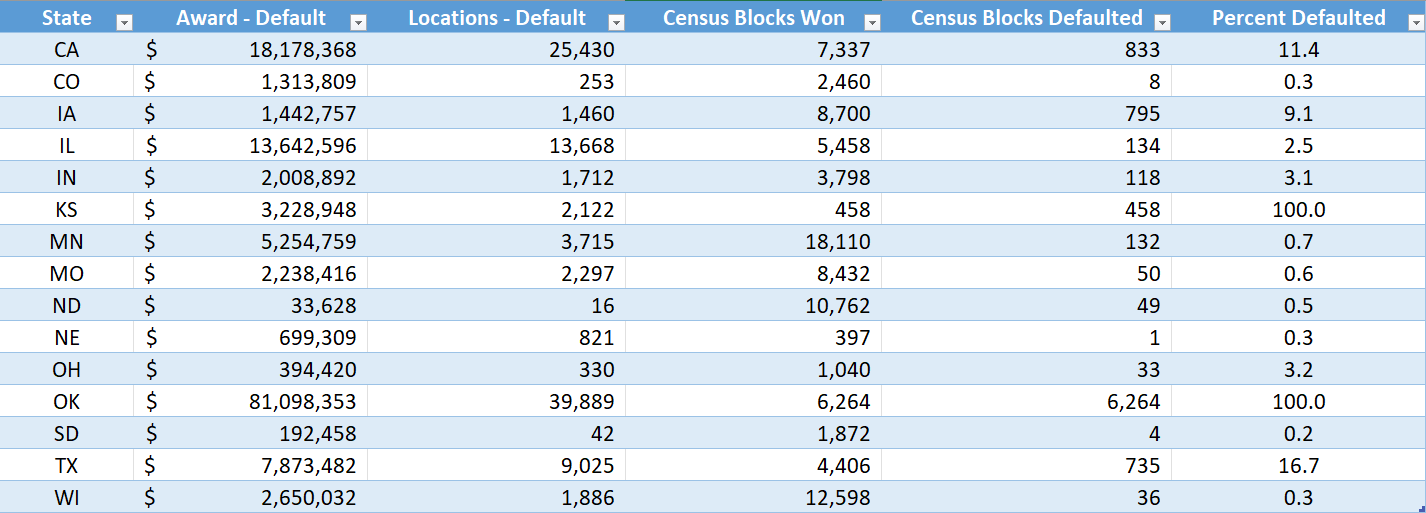
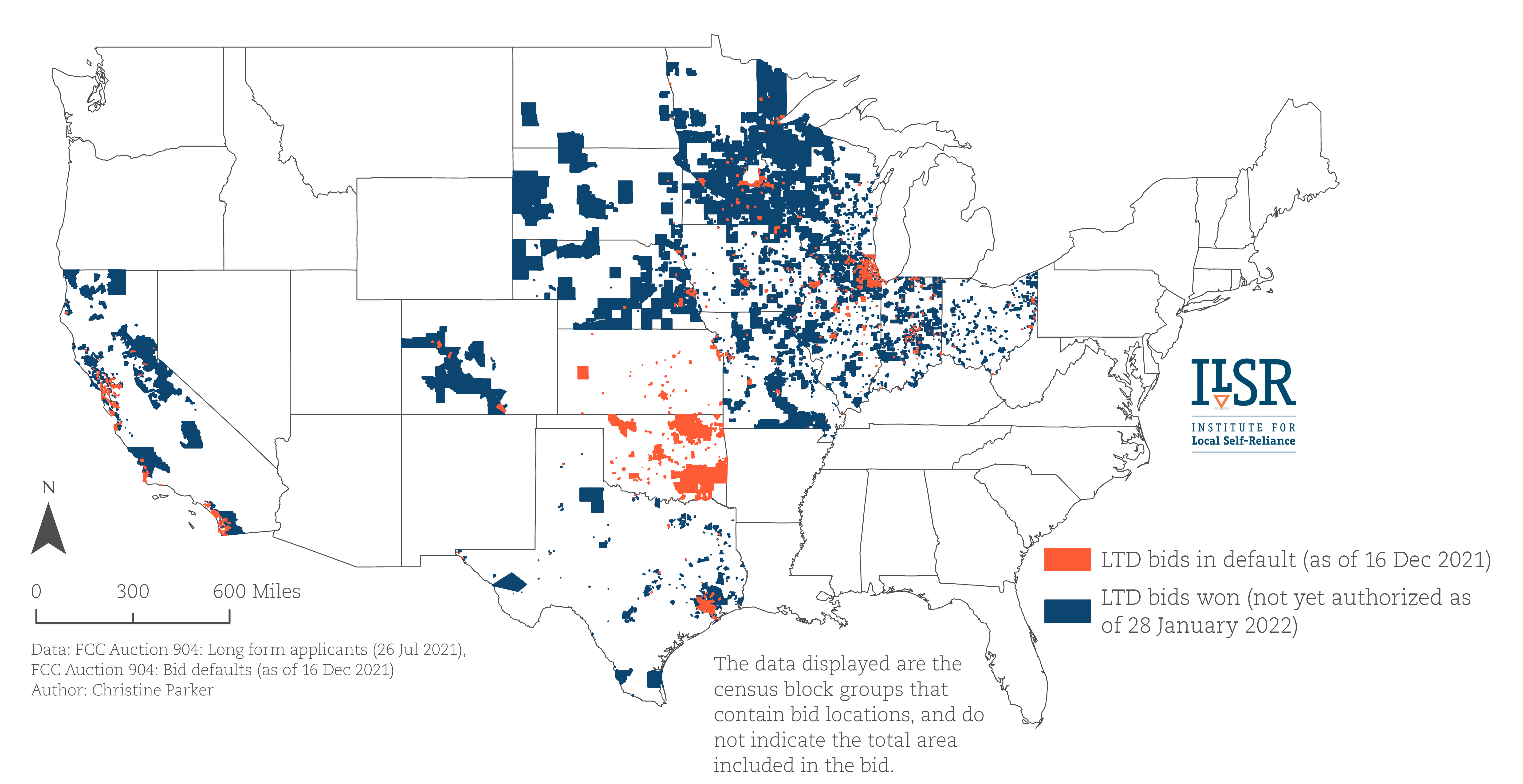
In looking at Defaults, it’s clear that LTD has some big problems on its hands. As of the middle of December, it had formally defaulted on more than $140 million of its bids (see table here, and map below or high-resolution version here). That includes 100 percent of the census blocks it won in Oklahoma and Kansas, 16 percent of its census blocks in Texas, and 10 percent of its census blocks in California and Iowa. Moreover, in the latest release on January 28th, the FCC announced that LTD defaulted on another 10,500 locations and $5.4 million.

What will ultimately happen with LTD, we still don’t know. In Iowa, the state Utilities Board has denied the ISP the Eligible Telecommunications Carrier (ETC) status the ISP needs to get RDOF funds and begin construction.

And we won’t know long term impact until – well long term…

The scandals surrounding RDOF have raised additional concerns about the federal government’s ability to effectively dole out the $42 billion in broadband spending lined up as part of the Infrastructure Investment and Jobs Act. While Congress has pushed the FCC to adopt numerous mapping reforms, most won’t arrive until after that money has begun to be awarded.

“We won’t know for years what the final extent of RDOF defaults will be,” Turner said. “The FCC’s pre-auction default policy, while stronger than the one from CAF-II, still lets winning bidders walk away from their deployment commitments years later, for a small fine. That encourages speculation, but of course to an unknown degree.”

Frustration in Le Sueur County about being stalled as RDOF gives dibs to LTD – but so far no contract

I’ve written about the situation in Le Sueur County before. They have been working to get better broadband for years. Then a provider (LTD) was awarded the possibility of getting a big chunk of federal money (RDOF) to bring FTTH in several parts of Minnesota including parts of Le Sueur. Le Sueur County News has more – and frankly the fact that a local paper gets into such details about a complex issue speaks to the priority and urgency the community feels…

Many under-served and unserved areas of Le Sueur County are now ineligible for Border to Border grant dollars since the Federal Communications Commission (FCC) auctioned over $408 million in grants to internet service providers to construct fiber optic networks across northeastern and southern Minnesota.

Of all the companies competing for grants, the largest sum is expected to go to a little-known ISP: LTD Broadband. The telecom provider bid for over $311,000 in 102,000 locations across the state. LTD’s planned fiber optic network encompasses approximately two thirds of unserved and under-served areas in the county.

Gov. Tim Walz announced the state would reject broadband grant applications in places that federal auction grant winners plan to build. State officials have claimed it would be wasteful to invest state dollars in projects overlapping with projects that could receive funds from the FCC’s Rural Digital Opportunity Fund (RDOF).

But the RDOF grants are still preliminary, and many experts have raised concern that LTD Broadband can’t meet its goals. At this time, LTD is a smaller provider with over 2,100 wireless towers, but the company aims to use $1.3 billion in grant monies to rapidly expand its service area to bring high speed internet to 500,000 locations across the country within the six-year time frame required by RDOF.

At that scale, local broadband advocates doubted that the federal grant money would go far.

“For the whole county, it’s $1 million in federal dollars for what is a multi-million dollar project,” said Le Sueur County Broadband Consultant Barbara Droher-Kline. “How viable is it for LTD, with $1 million, to bring fiber to the door of every household?”

The County continues to work for better broadband, but this RDOF process is currently creating more barrier than opportunity…

With federal dollars from the CARES Act, Le Sueur County pursued an aggressive strategy to expand rural internet access. About 420 homes in Waterville, Kilkenny, Montgomery, Cordova, Sharon, Lexington, and Kasota townships were connected to a 49-mile fiber optic network built by Metronet in partnership with the county.

Le Sueur County hoped to continue to build out from those networks with Border-to-Border grant applications, proposing to connect high speed fiber optic cables in Lexington, Montgomery, Kilkenny, Cordova, Sharon, Ottawa and Kasota townships. Fiber was planned to be in the ground this past spring, and the network would have been fully operational by the end of next year.

But the county’s applications were rejected by the state, since the RDOF award to LTD Broadband overlapped with the project area.

“It’s a blockage of dollars. It’s not a resource for us,’ said Droher-Kline.